

If willpower fixed a flat week, wouldn't your last three pep talks have worked by now?
Most advice on why do I feel so unmotivated treats your brain like a stubborn mule that just needs a louder alarm and a stricter routine. You try to push harder, you stall out anyway, and then you sit on the edge of your bed wondering what's wrong with you.
Nothing is broken just because your drive went missing. Low motivation isn't a personality verdict. It's a dashboard light telling you something specific is blocked, whether that's short sleep, burnout, an overloaded to-do list, avoidance, or a low mood that needs real care.
Once you figure out which system is stalled, you can stop yelling at yourself and match the fix to the problem.
Figure Out Which Kind of Slump You Are In
Two people can stare at the same blank Google Doc for an hour and be stuck for completely different reasons. One person slept five hours and can't hold a single thought together. The other person has fourteen half-finished commitments fighting for space in their head.
A lot of self-help lumps every flat spell under laziness, even though researchers separate these states. A 2025 study published in PMC looking at 994 participants found that apathy (reduced self-initiated behavior) and anhedonia (reduced pleasure or reward) both change how willing people are to put in effort for a payoff, pointing to perceived effort rather than a discipline failure. A separate 2025 longitudinal study noted in the same review followed 470 young adults for 4.5 years and found that executive and emotional apathy predicted later shifts toward depression and psychosis.
Burnout can wear the exact same disguise, too. In 2024, 45% of the U.S. workforce reported experiencing burnout, with the rate climbing to 54% among Gen Z workers and 52% among millennials, according to an Eagle Hill Consulting Ipsos survey. When your battery is empty, trying to hype yourself up just burns the last two percent.
Match Your Slump to Your First Move
Use the table below to spot your closest pattern. Treat it as a quick sorting tool for everyday slumps, not a medical diagnosis.
| What It Feels Like | Likely Cause | First Move Today |
|---|---|---|
| Tired, foggy, everything takes longer | Short or broken sleep | Protect tonight's sleep and do one easy task |
| Bored by things you used to enjoy | Missing challenge or novelty | Try something new for 10 minutes |
| Wired but can't start anything | Overwhelm from too many open tasks | Write the single next step and nothing else |
| Drained after small efforts | Burnout | Drop one commitment and schedule real rest |
| Nothing feels good, even fun things | Possible low mood or depression | Talk to a doctor or counselor if it lasts more than a few weeks |
| Scrolling to feel something, then guilt | Stress, threat-watching or avoidance | Name what you are avoiding and swap in one small action |
Pick the row that sounds most like your week. If two rows fit, start with the easiest lever to pull right now, which is usually sleep or cutting down overwhelm. When a scattered head keeps dragging your focus away from whatever you pick, practical tips on improving your attention span can help you clear the noise enough to begin.
Start with the timeline: Ask yourself whether this flat feeling has lasted a few rough days or several straight weeks.
A three-day dip after exams or a hectic shift usually responds to a basic reset. A stretch that drags on for weeks without lifting is your cue to look deeper.
When Low Motivation Needs More Than a Reset
Sometimes a cold shower and a tidy desk won't touch the heaviness, because the problem isn't your workflow. The World Health Organization estimated that about 280 million people experienced depression worldwide in 2019, including roughly 5% of adults. Depression directly affects interest, energy, concentration, sleep, and your capacity to feel pleasure, which are the exact gears you need to start a task.
Brain imaging backs up why "just do it" falls flat during a depressive episode. A neuroimaging meta-analysis in Psychological Medicine found reduced activation in the right striatum, including the putamen and caudate, along with changes in the subgenual anterior cingulate cortex when people processed rewards. You can know perfectly well what needs doing and still feel zero internal pull toward it.
Low motivation still has plenty of other triggers, from grief and anxiety to thyroid issues, low iron, or medication side effects, so only a qualified clinician can tell you what's going on. A short slump after a stressful week is normal. A heavy fog that settles in and keeps getting worse deserves real support, and reading counselling insight on depression and fatigue from Therapy with Ben can help you put words to how mood and exhaustion tangle together.
Signs Worth Booking an Appointment For
Consider reaching out to a doctor, campus counselor, or therapist if you notice these patterns sticking around:
- Persistent numbness or low mood: Feeling flat, sad, or uninterested in almost everything, including hobbies and friends, for more than a few weeks.
- Noticeable body shifts: Ongoing changes in your sleep or appetite that don't match a temporary schedule shakeup.
- Daily life slipping: Trouble keeping up with classes, work, basic chores, or self-care like showering and eating regularly.
- A sense of hopelessness: Feeling convinced nothing will get better no matter what you try.
To make that first appointment less intimidating, jot down four quick notes on your phone beforehand. Write when the flatness started, what your sleep has looked like, any big changes or stressors in your life, and what you've already tried. Handing a doctor clear notes takes the pressure off trying to explain everything on the spot.
If you are having thoughts of hurting yourself, please contact your local emergency services or a crisis line in your country right now. Don't wait for a future appointment or try to push through it alone.
Needing medical or mental health care isn't a personal failure. It's basic maintenance when a tune-up at home isn't enough.
How Poor Sleep Drains Your Drive
Trying to feel motivated on short sleep is like trying to stream video on one bar of service. The show is technically playing. It just keeps freezing at the good part. According to the U.S. Centers for Disease Control and Prevention, 35% of adults got insufficient sleep in 2020, defined as fewer than seven hours on average, and short sleep is linked with both anxiety and depression.
Here is the part nobody warns you about. A tired brain doesn't just feel groggy; it recalculates whether effort is worth it at all. Research published in the journal Sleep showed that sleep-deprived participants were less willing to exert effort, with reduced reward-related attention in the anterior cingulate cortex and anterior insula, while striatal reward circuitry leaned harder toward immediately gratifying stimuli. In plain words: your brain still wants rewards, it just stops believing the slow ones are real. Studying, cooking, or answering emails suddenly feels like pushing a sofa uphill, while auto-playing clips still feel effortless because the payoff arrives in seconds.
Phones sit right next to that fault line. A 2025 Pew Research Center report found that 45% of U.S. teens ages 13 to 17 said social media hurt the amount of sleep they get, and 40% said it hurt their productivity. That doesn't mean phones single-handedly cause low motivation. It means scrolling late at night steals the exact recovery your brain needs tomorrow morning, and tomorrow-you inherits the bill.
So when you catch yourself thinking "I have no discipline," check the simpler question first: how did you sleep?
Your Bad-Sleep Day Plan
When you wake up wrecked, treat today as a temporary capacity issue instead of a test of character:
- Anchor your wake time: Get up close to your normal hour even after a rough night, so you don't wreck tomorrow's bedtime too.
- Chase morning daylight: Step outside or sit near a bright window for a few minutes right after waking to reset your body clock.
- Fuel before you work: Drink a glass of water and eat something with actual substance before opening your laptop.
- Shrink one priority: Pick one task that matters today and cut it down to a five-minute version, like opening your notes and outlining three bullet points.
For the next one to two weeks, keep a dead-simple log of your bedtime, wake time, and how foggy or steady your day felt. Patterns jump off the page fast, especially when late-night feeds are eating into your sleep window. If you're clocking plenty of hours and still waking up exhausted, this guide from Resty on restless nights breaks down why sleep quality can lag behind sleep duration. And if heavy fatigue keeps hanging around even when your sleep looks solid, book a checkup with a clinician rather than blaming your discipline.
Why Scrolling Beats Starting Something Good
You plan to go for a walk, sketch for a bit, or finish a module. Five minutes later you're deep in Reels, mildly annoyed at yourself, and wondering how your thumb got there so fast.
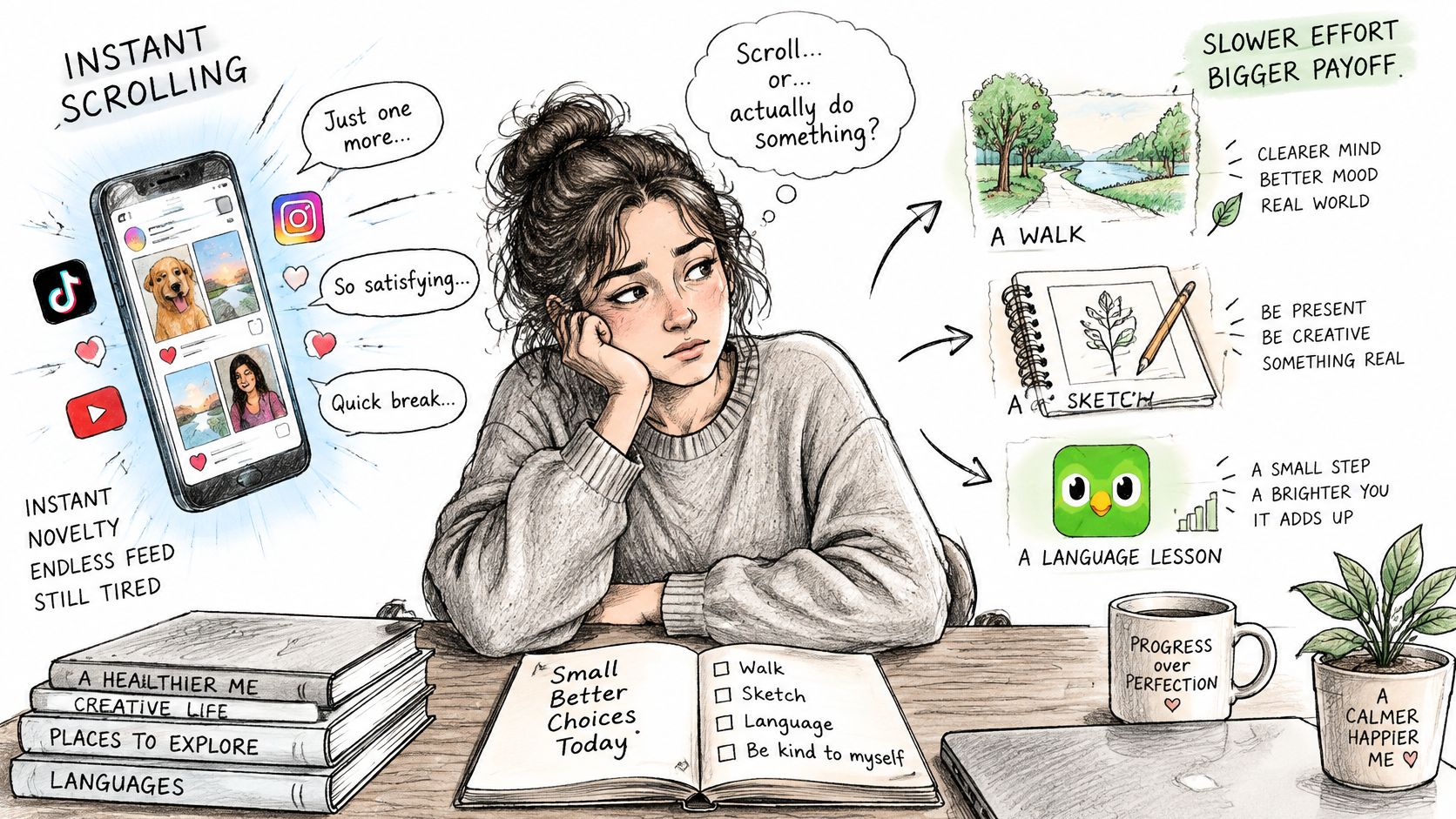
A walk, a drawing, or a language lesson asks for upfront friction and pays you back slowly. A feed has zero start-up cost and delivers novelty in half a second. The second a real task feels awkward, boring, or slightly stressful, your hand reaches for the easiest relief in the room.
Here is a visual look at that daily fork in the road between an instant feed and slower activities that restore your energy.
A lot of phone advice misses what scrolling is doing for you. A 2025 preregistered study in APA PsycNet of 677 university students found that hypervigilance helped explain doomscrolling among marginalized participants, showing that constantly checking feeds can be driven by perceived threats of discrimination or exclusion rather than simple entertainment. Meanwhile, a 2023 meta-analysis in the Journal of Computer-Mediated Communication reviewing 141 studies and 145,394 people found that active and passive social-media use had mostly negligible links with 13 well-being measures overall, though passive scrolling brought worse emotional outcomes in general feeds (unlike inside genuine groups).
Five Jobs Scrolling Quietly Does
When you catch yourself opening Instagram or TikTok on autopilot, you're usually looking for one of five things:
- Threat-watching: Checking breaking news over breakfast because staying alert feels safer than looking away.
- Social connection: Watching strangers talk on YouTube at night because your room feels too quiet.
- Emotional avoidance: Scrolling at 1 a.m. after an awkward text or a rough shift so you don't have to sit with the feeling.
- Pure habit: Tapping an app the instant an elevator door closes or a webpage takes three seconds to load.
- Reward-seeking: Hunting for one funny video or quick dopamine hit when a tedious assignment feels dull.
This explains why slamming a hard wall over an app often backfires. Take away the feed without addressing the itch underneath, and boredom or anxiety rushes straight into the gap, which is why people delete timers or tap "ignore limit" ten minutes later. If endless feeds are your main trap, learning how to stop doomscrolling starts by naming the job the scroll is doing before you swap it out.
The next time you pick up your phone mid-task, pause for three seconds and ask what you're hoping to get. Want connection? Text one friend directly instead of lurking on stories. Feeling wired or anxious? Take five slow breaths with a longer exhale. Avoiding a dreaded email? Open a blank draft and type just the subject line.
For a deeper look at why your brain gravitates toward easy distraction over hard starts, watch the breakdown below.
Standard app blockers like Screen Time limits or Freedom do one thing well: they put up a crisp, predictable wall, and for some people a strict cutoff is helpful. The weak spot is what happens the moment you hit that locked screen with nothing else queued up. Badger works differently because it acts as a personal agent, adapting to how strict you need it to be and stepping in with something concrete to do instead of leaving you staring at a gray screen.
Five Gentle Ways to Restart Momentum Today
Waiting to feel inspired before you move is a great way to lose an entire Thursday. In psychology, behavioral activation flips the usual order: you take one tiny, observable step first, and your brain updates its energy level after seeing you move.
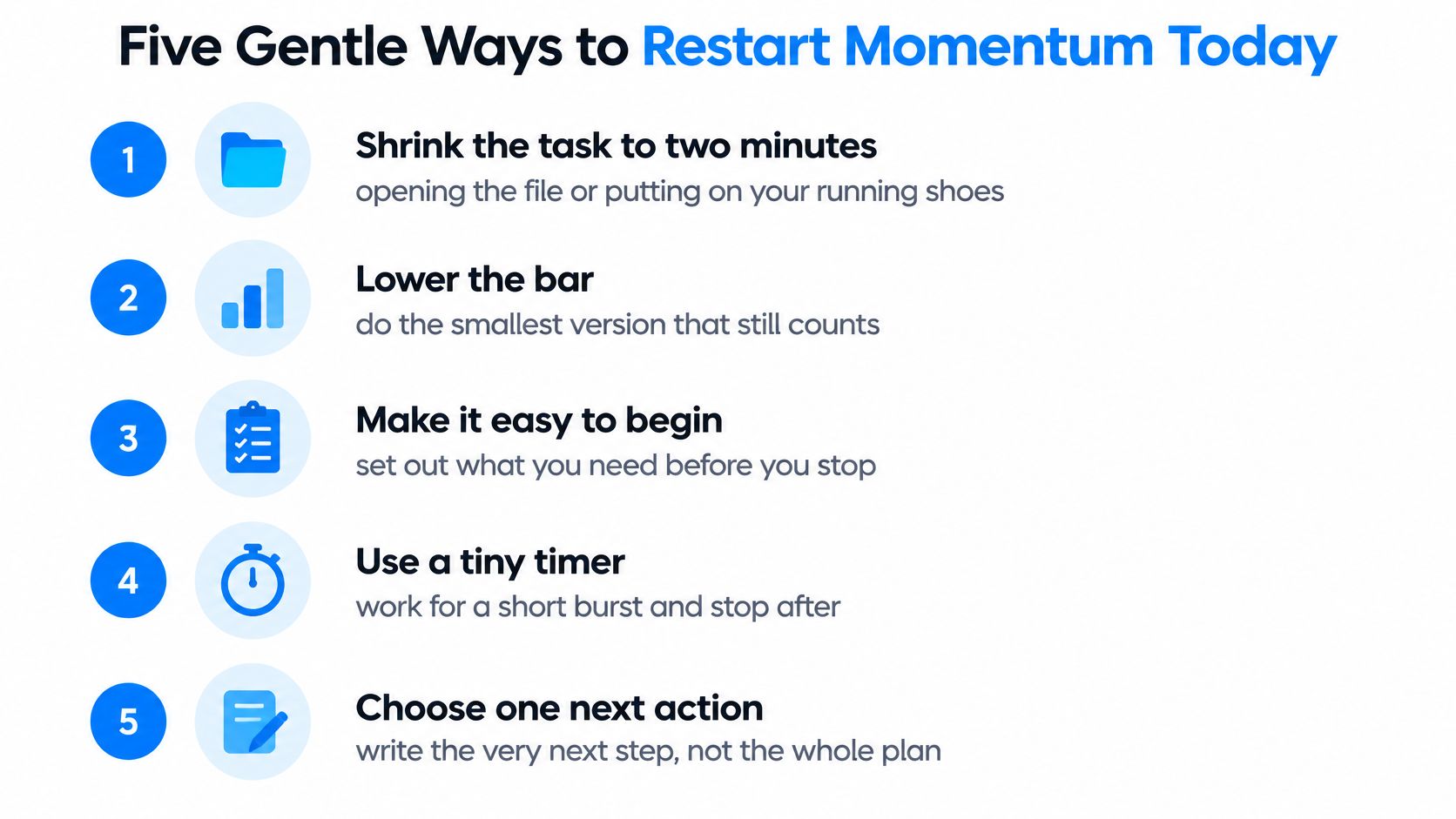
This infographic lays out five low-friction moves you can use when your drive is stuck at zero.
You don't need all five at once. Pick one that fits today's energy and run it without waiting for your mood to catch up.
- Shrink the task to two minutes. Don't aim to "write the essay" or "go for a five-kilometer run." Open the file and type one ugly sentence, or lace up your running shoes and step onto the porch. Starting burns the most mental fuel, and once you cross the threshold, continuing gets far easier. The usual slip is sneaking a 30-minute expectation into a "tiny" step, which makes your brain slam the brakes again.
- Attach it to something you already do. Memory is terrible when you're tired, so piggyback on an existing habit instead. Step outside right after lunch, or read a page the second you set your toothbrush down. People often slip here by picking a shaky anchor like "sometime in the afternoon" rather than a clear physical cue.
- Change the environment before you start. Set up the room so the right move takes less effort than the distraction. Leave your phone charging in another room, put your paperback on your pillow, or set your sketchbook and pen on the desk before bed. Most folks wait until the moment of low energy to hunt for supplies, and those extra thirty seconds of friction are enough to kill the attempt.
- Log each completed action. Draw a check mark in a notebook, tick a box in Notes, or jot down a two-word win after you finish. Visible proof trains your brain to expect a payoff from showing up, which builds traction faster than distant goals ever will. Skipping the tick sounds harmless, yet it's the quickest way to forget you did anything and end the night feeling like you wasted the day.
- Choose a reward that isn't a feed. Give yourself a real treat once the small action is done: a walk with a favorite playlist, a good snack, or texting a friend what you just finished. Even "active" social media isn't a magic mood boost. A 2022 randomized trial in New Media & Society followed 381 adult Instagram users for a week and found that posting pictures raised positive affect slightly, yet produced no meaningful gains across other well-being outcomes. Offline movement, hobbies, and real conversation still hit differently, and the common slip is rewarding ten minutes of focus with forty minutes of TikTok that wipes out your focus.
Momentum doesn't show up to carry you off the couch. It shows up about three minutes after you start anyway.
Pacts and Your Group Keep You Going
Going solo on a flat week is tough because nobody notices if you bail. Doing something alongside even two or three other people changes the math right away. You pick something you care about, you watch your streak build, and real humans see when you show up.
Self-determination theory explains why that setup works so well. A 2019 study published in APA PsycNet of 1,549 secondary-school students in Singapore tested three core psychological needs: autonomy, competence, and relatedness. Satisfying all three was linked with stronger autonomous motivation, more enjoyment, higher perceived value, and less pressure, and relatedness made the biggest contribution of the three.
What a Pact Looks Like in Real Life
A pact is one simple promise you keep with your group. You choose what matters to you (autonomy), track your check-ins (competence), and do it alongside people on the same wave (relatedness).
Sample pacts cover everything from basics to fun side quests:
- Walk more: Getting out for regular walks to clear your head and move your legs.
- Read more: Reading a few pages every day so that stack by your bed finally shrinks.
- Learn Spanish: Practicing a little every day until ordering coffee or watching a show clicks.
- Draw: Sketching on a regular rhythm just to get better with your hands.
- Touch grass: Getting outside more often so your whole day doesn't happen under ceiling lights.
Whether you call it habit maxing, hobby maxing, or life maxing, the goal is putting real stuff back on your calendar, like getting fitter, getting smarter, or getting really good at something you enjoy. If putting things off has been your main hurdle, pairing a shared commitment with practical time management for procrastinators makes starting feel much lighter.
Inside a pact, you see your own progress, who in your group has already checked in today, and a group chat where you can react to posts or send a friendly poke to someone who hasn't shown up yet. Badger is a personal agent for iPhone that steps in when your scrolling runs long and nudges you toward a pact you wanted to do. Of course, an app isn't the only way to get that pull. Joining a friend's regular walk, signing up for a local climbing session, or texting a buddy a photo of your finished sketch every evening gives you the same social lift.
Pick One Small Thing to Do Before Tonight
You don't need a brand-new life by Monday. Pick one row from the slump table that sounded uncomfortably accurate, pair it with one of the five restart moves, and do the two-minute version before you go to sleep tonight.
Write that tiny action on a sticky note, or set a reminder for the exact same time tomorrow. Then lock it into an if-then plan, the trick psychologists call implementation intentions. The idea is simple: you decide the move before the moment arrives, so the moment never gets a vote. Scrolling habits run on autopilot, and autopilot loses every argument you have with it at 11pm. A pre-decided rule skips the argument entirely, because the choice was already made by a calmer version of you.
Two Rules Small Enough for a Bad Day
Keep your rule so light you could pull it off even when your mood is in the basement:
- After lunch: "When I open Instagram after lunch, I first stand up and walk to the window."
- At bedtime: "When I reach for TikTok in bed, I put the phone face down and read one page."
Notice how small these are. That is the point. A rule you can keep on your worst day beats a heroic one you abandon by Thursday, because every kept repetition teaches your brain that starting is normal, not a battle.
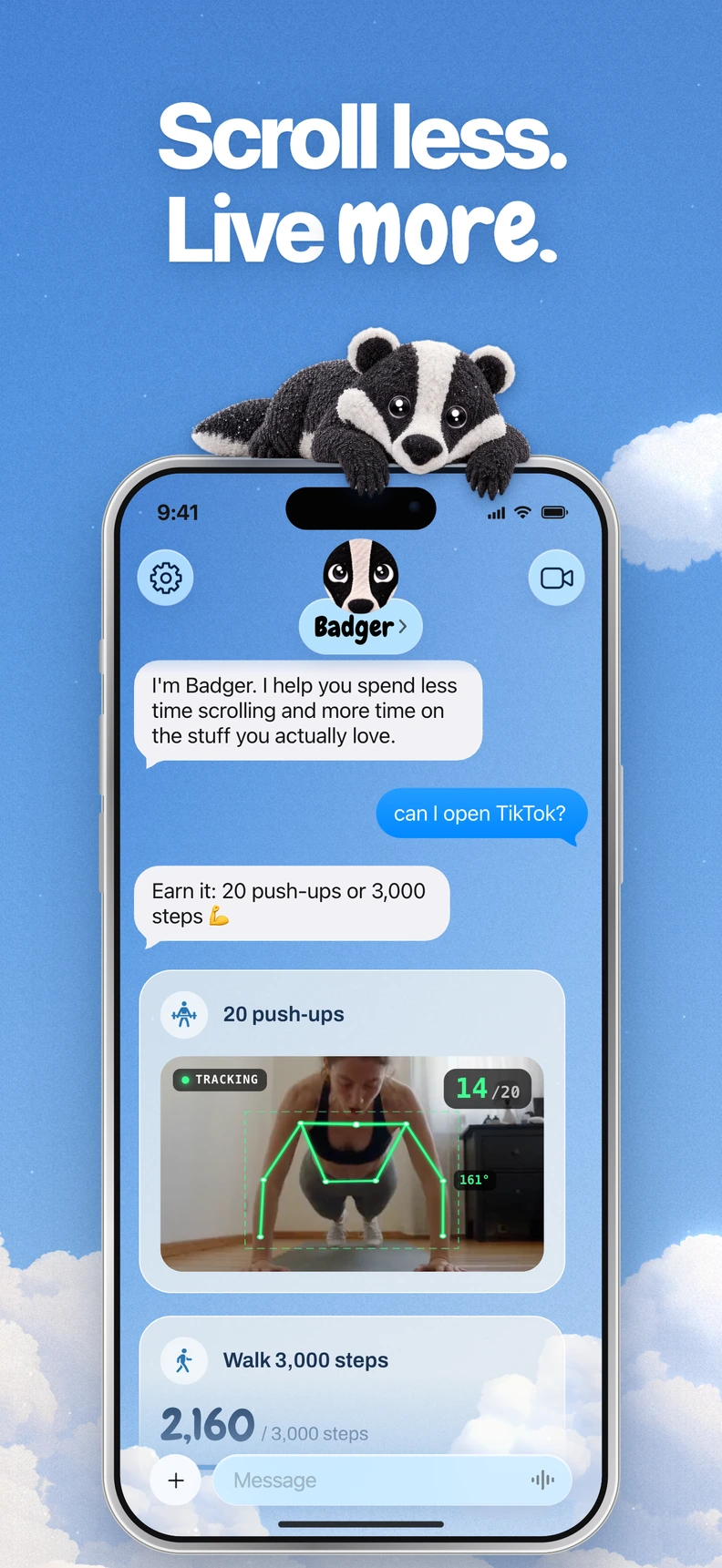
You can run an if-then plan on paper, in your Notes app, or with a friend. If you want backup holding the line, you can text Badger to talk about your goals, make a plan, and ask Badger to take action. Badger can block distracting apps and help you adjust when your day changes. When your scrolling runs long, it steps in and brings up the pact you said you wanted to do, like walking, reading, or drawing.
Ready to trade flat, stalled evenings for habits and hobbies you look forward to? Badger is a personal agent for iPhone that steps in when scrolling runs long and gives you a pact and a small group to move toward instead. Visit Badger to grab the App Store download and pick your first pact today.
Questions or corrections? Use Badger Support. More on the Badger blog.