

You open the book, read the same paragraph three times, and realize you couldn't tell anyone what it said. Your phone is face down. You're not even tired. Your eyes moved across the words and your brain just didn't show up.
That's the normal version of a reading problem, not a character flaw. Reading isn't a steady beam of attention. Your eyes jump, stop, jump again, and your mind has to keep stitching meaning across all those stops (the reading eye-movement research archive traces this back to the late 1800s). Concentration is the stitching. It's a routine you run, not a personality trait you're missing.
Here's the routine I'd use: set the room up so your phone can't win, read in short blocks, and get back to the page fast when you drift. Three parts, start tonight.
Which Phone Cues Actually Pull You Away
A buzzing phone and a silent phone on the same desk are two different problems, and they don't cost the same amount of reading. Treating them as one habit is why "just put it away" advice keeps failing. Some cues are expensive, some are close to free, and one is mostly about how the page itself is built.
| Phone cue | What the research found | How much it matters |
|---|---|---|
| Notifications switched on | 2016 study of 221 adults: more inattention and hyperactivity symptoms when alerts were on | Clear effect on inattention in this study; the easiest cue to switch off |
| Phone visible but silent | No measurable difference in reading performance whether the phone was in sight or out of the room | Small or none in the studies reviewed |
| On-screen distractions | Readers spent 1.87% of reading time on them, about 4 seconds in a four-minute interval | Small share of time, but the first distraction held attention about 2,000 ms |
| Scrolling digital text | Paper beat digital by g = 0.35 to 0.48 when scrolling was required | Moderate when scrolling; g = 0.03 to 0.12 when scrolling was not required |
Start with the top row, because it's the cleanest signal and the cheapest fix. A 2016 experiment with 221 adults across two one-week periods found people reported more inattention and hyperactivity symptoms when notification alerts were on, and greater inattention predicted lower productivity and well-being (the CHI study on notification alerts has the details). The buzz keeps working on you after it's over, which is why "I only glanced at it" sessions still feel scattered twenty minutes later.
The silent phone row is where the advice gets preachy and the evidence gets thin. In the studies reviewed, phone presence by itself showed little or no measurable effect on reading performance: a silenced device in plain sight performed about the same as no device in the room. Keep it out of reach anyway. The alert is the lever that moves your attention, and a drawer removes the question entirely, so you never spend focus resisting an object.
The distraction you barely notice
On-screen distractions take a surprisingly small slice of the clock. In a 2025 study published in the Journal of Computer Assisted Learning, readers spent an average of 1.87% of total reading time looking at distraction areas, roughly 4 seconds in a four-minute interval. That number undersells the cost. The first distraction held attention for about 2,000 milliseconds, and re-finding your place in the text costs far more than the glance itself.
Scrolling is the bigger structural tax. When a text required scrolling, paper beat digital by moderate effect sizes; when it didn't, the gap nearly vanished (the paper versus screen meta-analysis breaks this down). If you're deciding what to change first, go alerts, then long feeds. A fixed-layout page beats an infinite one for the same reason a chapter beats a timeline.
Treat all of this as averages. Your triggers are specific: maybe it's one group chat, maybe it's an app that opens into a feed. If you want a wider set of moves beyond the reading desk, these practical ways to cut screen time cover the everyday side. And if the session keeps dying at the same app, here's how to block apps on iPhone without relying on a timer you'll ignore.
Set Up a Reading Spot in Five Steps
Set the room before you open the book. Five steps, five minutes, and each one removes a cue from the table above so you're not relying on willpower at the exact moment willpower is weakest.
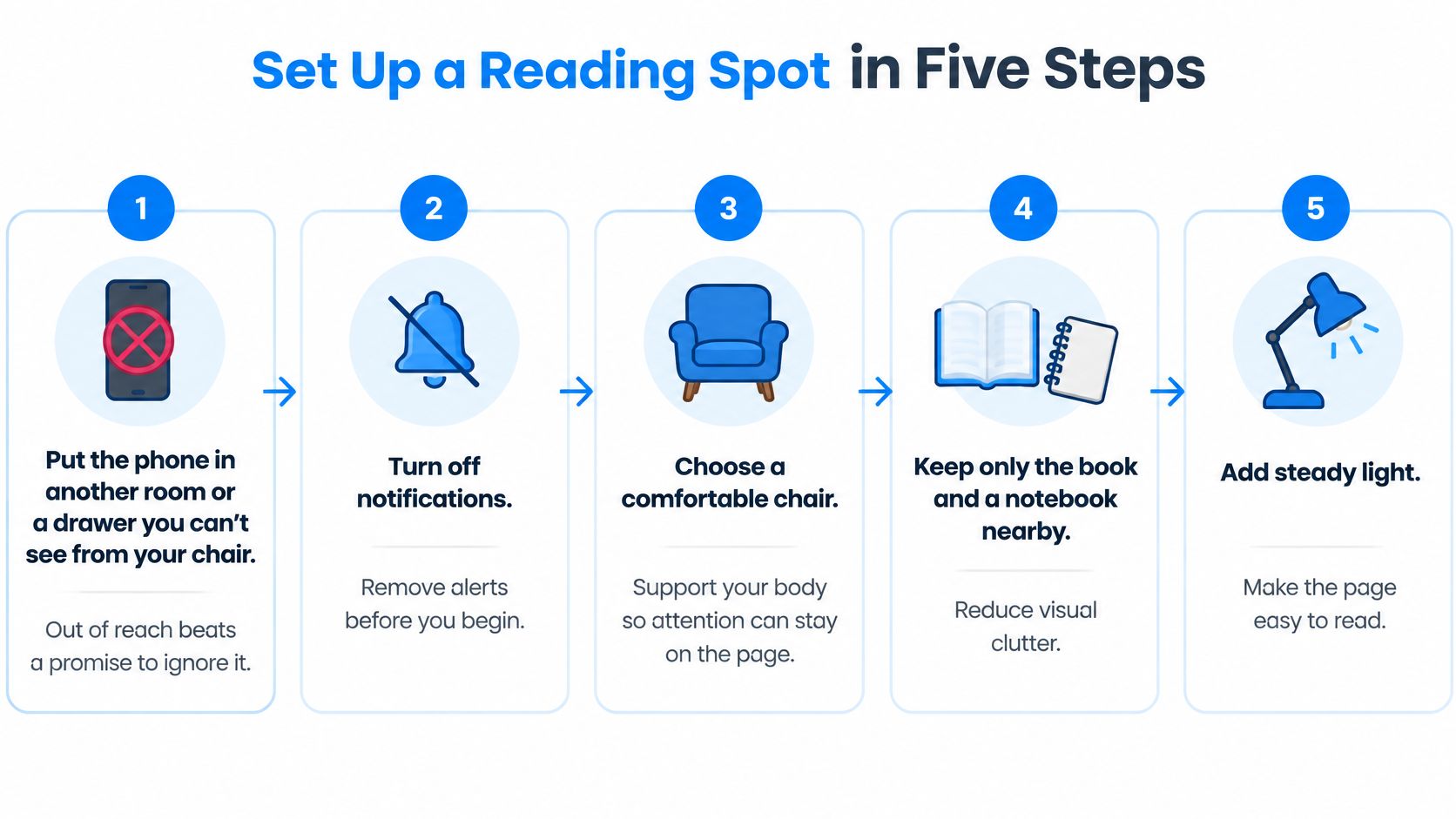
- Put the phone in another room or a drawer you can't see from your chair. Out of reach beats a promise to ignore it, because the promise gets tested every few minutes and the drawer doesn't.
- Turn off notifications and lock-screen previews. Not silenced. Off. A preview is the notification doing its job through glass.
- Close every other tab and app on a laptop or tablet. One document open. Not "one document plus email in case something comes in."
- Pick your format on purpose. A printed book or a fixed-layout page is easier to stay with than a long feed you keep scrolling. Use paper for anything dense.
- Decide your start and stop point before you begin. One chapter, or a block of about fifteen minutes. Mark the spot. Knowing where you'll stop makes starting less vague.
The reasoning behind steps one and two is the strongest finding in this whole area. In that 2016 experiment, participants reported more inattention and hyperactivity symptoms when notifications were on, and greater inattention predicted lower productivity and psychological well-being. The takeaway is unglamorous: silence alerts and put the phone away before you start reading, because once the interruption has landed, you're already negotiating.
What a ready setup looks like: phone quiet and out of sight, one page open, notebook beside it, and you already know which line you'll stop on. If one of those is missing, fix it first.
A note on lighting and chairs, since most guides skip it. You don't need a beautiful reading corner. You need the page bright enough that your eyes aren't working, and a seat where your back isn't asking for attention. Discomfort is a distraction with good manners. It doesn't announce itself, it just keeps tapping.
Read in Short Blocks and Check Your Recall
This is the part that changes reading from exposure into learning. It also feels worse than highlighting for the first week, which is how you know it's working.
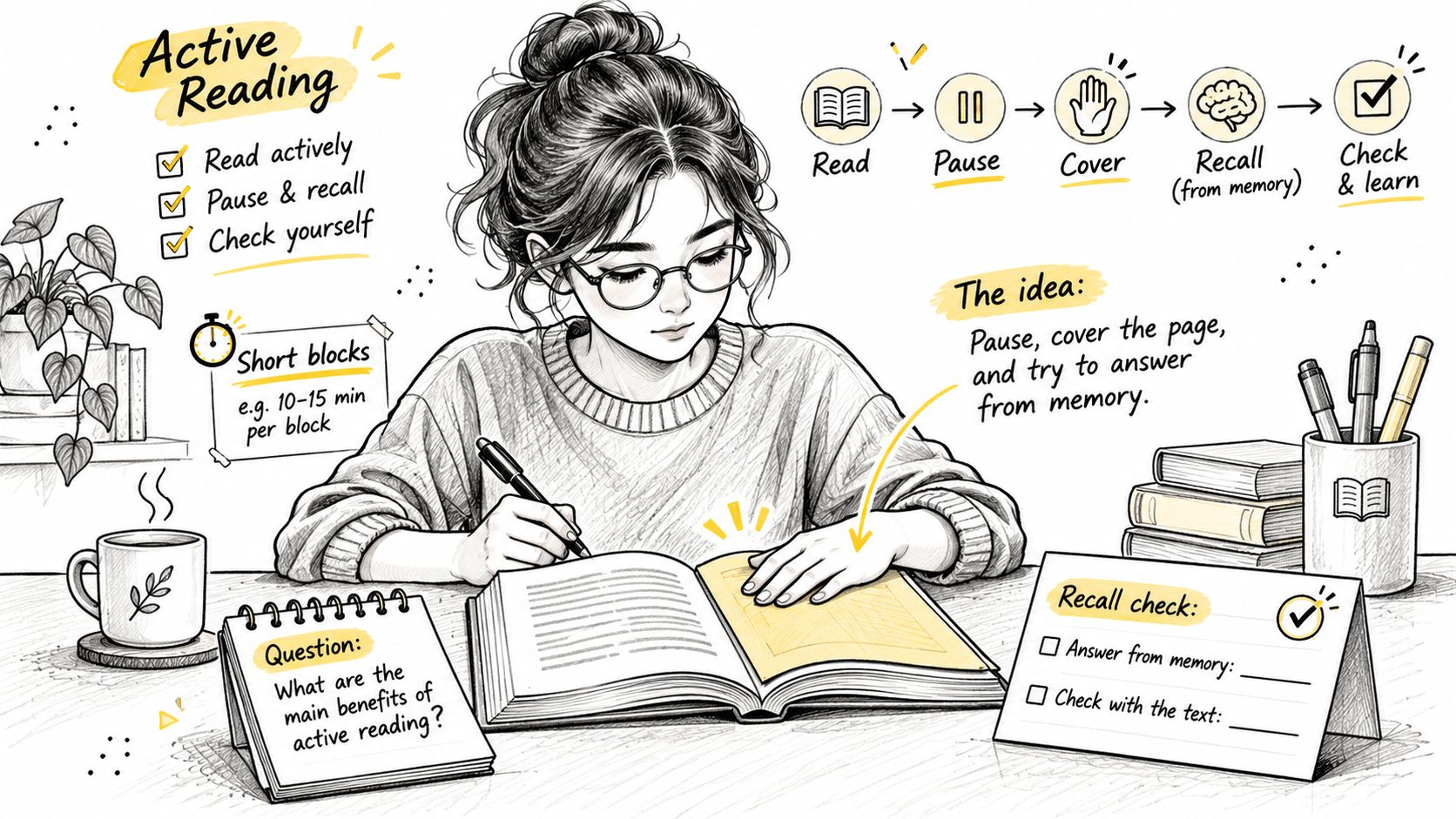
- Write one question before you read. Something concrete: "What are the author's three causal claims?" A question gives your attention a job other than staying awake.
- Read a short section, about 5 to 10 minutes, and stop at a checkpoint you picked in advance. Deciding when to stop mid-page is how a block becomes an hour of skimming.
- Close the book or hide the page and recall the main claim plus two supporting details. From memory, no peeking. This is the step everyone skips.
- Produce something from memory. A one-line answer, a small example, a scribbled diagram. Making it forces the material through your own words.
- Check it against the text, fix the gaps, move on. The mismatch between what you remembered and what's on the page is where the learning happens.
Honest size of the gain: a large research synthesis reported an average retrieval-practice effect of 0.70, while classroom-based evidence found a more conservative g = 0.37 (the review of retrieval practice research explains the gap). Expect a real, modest improvement, not a transformation. A practical benchmark: if you can't recall the section's thesis and two details, your next block was too long.
The pitfall is fluency. Highlighting and rereading make material feel familiar, and familiarity feels like knowledge right up until someone asks you a question. Colored lines are not evidence. Neither is the warm feeling of rereading a paragraph you've now read four times.
Two more traps worth naming. Recall only at the end of a long chapter, when the first half has already gone cold. And recall without spacing, when coming back to the material tomorrow would do more than another pass today. If you're building this into schoolwork, these active recall techniques for high school students apply the same principle to notes and revision. If the bigger problem is starting at all, the fix usually lives in time management for procrastinators rather than in a longer reading block.
Recover from Mind Wandering Instead of Quitting
Good readers don't hold a perfect streak. They notice the drift sooner and come back faster. That's the whole skill, and it's trainable.
Mind wandering shows up a lot during educational reading, around 30% of the time on average across activities, and one connected-text study recorded 47% (the mind-wandering and reading comprehension research covers this and the selective damage to recall of central ideas). If you drift through a page, you're inside the normal range, not outside it.
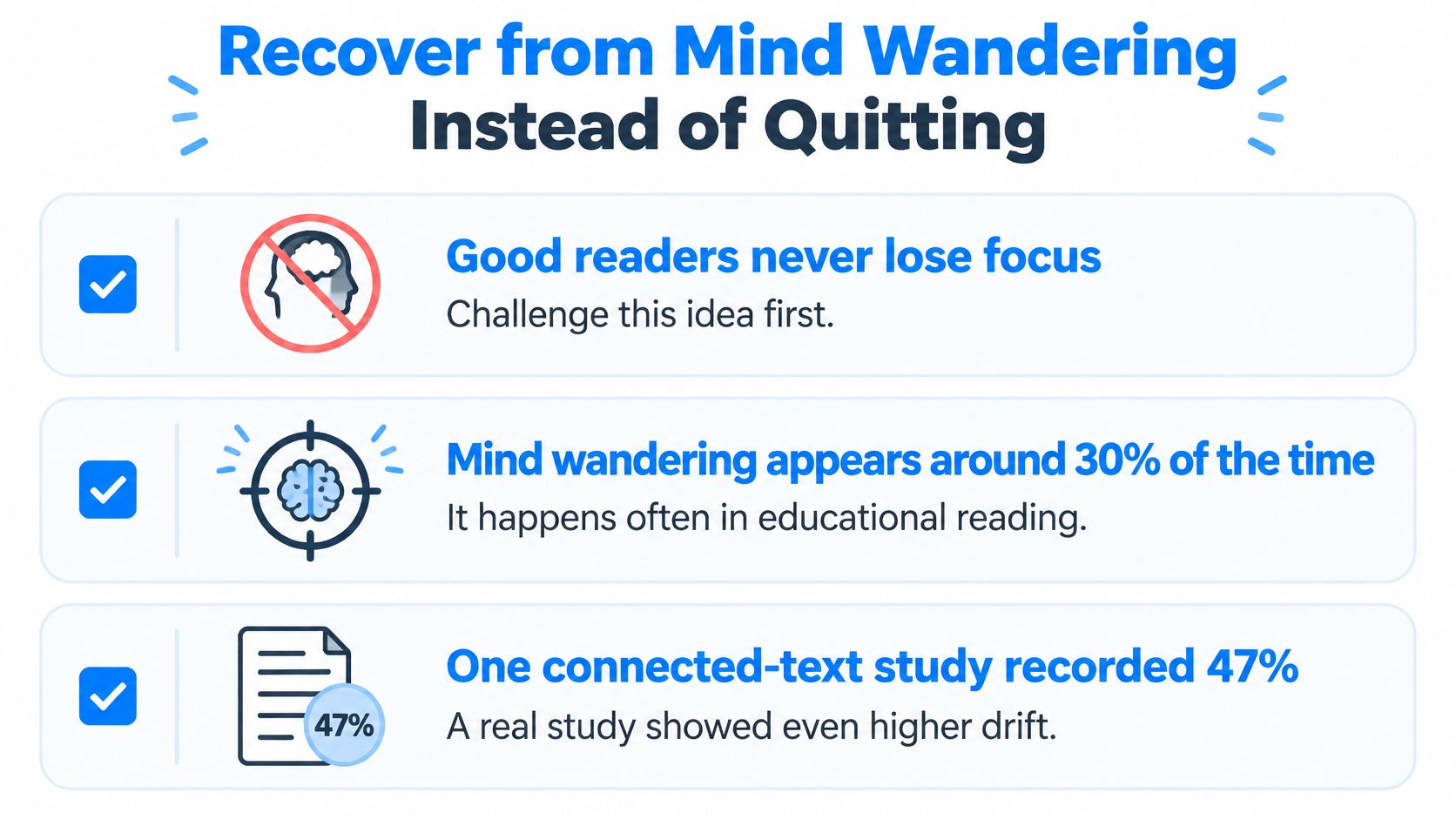
What distractions cost is measurable. A 2024 digital-reading experiment with 22 participants, who read 10 documents containing interruptions like notifications and pop-ups, found the distractions significantly disrupted reading flow, reduced comprehension, and increased frustration (the study on distractions in digital reading also found cognitive-control training improved comprehension in distracting environments). Focus can be practiced. Removing the interruption is still the cleaner first move.
The reset, in order
- Write an if-then plan. "If I feel the urge to check an app, I'll mark the page, take one breath, and read the next sentence." Plans shaped like this beat the vague goal "I won't get distracted," because a plan tells you what to do instead.
- Read for a fixed, modest interval. Ten to twenty minutes. Short enough that you'll finish one.
- When attention drifts, label it once and go back to the last sentence that made sense. Not the top of the page. Restarting a chapter because of one lost paragraph is how a twenty-minute read becomes an hour of rereading.
- Finish by writing the passage's central claim. One sentence. If you can't write it, you didn't finish reading, you finished looking.
- Track recovery latency. Count the seconds between noticing the drift and resuming. That number is a better scoreboard than pages read.
Have a replacement ready for the gap. A short walk, a glass of water, five minutes on something you're trying to get better at. If removing the distraction leaves a vacuum, the distraction comes back and brings a friend.
Stop scoring yourself on whether you drifted. Score yourself on how quickly you came back.
Build a Reading Habit That Sticks
A routine you can repeat beats a heroic session you can't. Three parts, all small.
Pick a block short enough to finish. One section, or about fifteen minutes, at the same time each day. The point isn't volume. It's that tomorrow's session starts with a decision already made, and a block this size survives the days when everything else runs late.
Keep the format simple. Eye-tracking research with students has linked reading on screens to weaker comprehension than reading on paper, so where you can, reach for a printed book or a fixed-layout page. When a screen is your only option, strip the friction you can control: full-screen mode, notifications off, one document open. Removing small escape routes matters more than finding the perfect device.
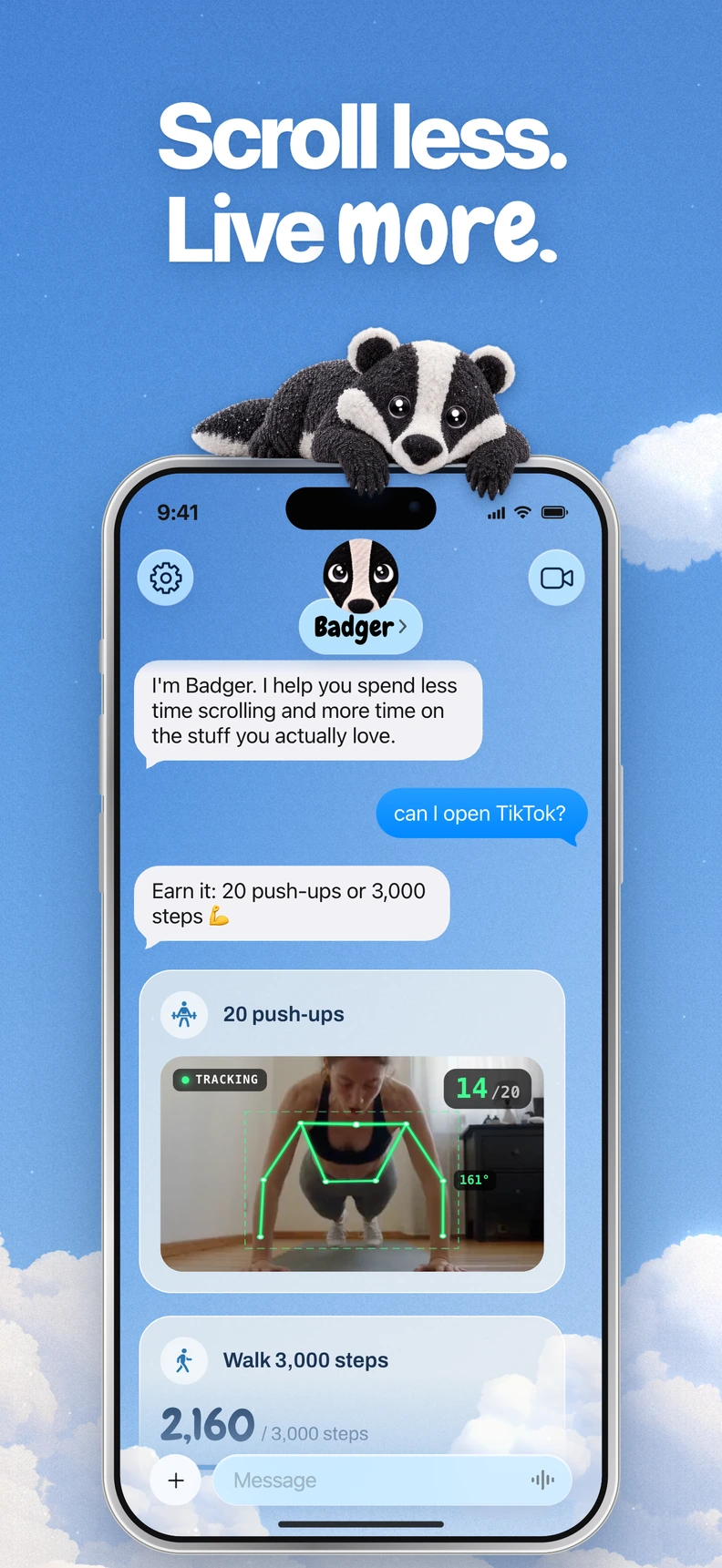
Use a small group for accountability. A pact like Read more in Badger means committing to a few pages a day alongside other people who can see whether you showed up. That's the part solo habit apps never solved: a timer doesn't care whether you did it. People do. You can join a pact with friends or get matched into a small group, and a missed day is visible rather than forgotten.
A good week looks like most days done and one missed day treated as information rather than failure. Miss twice in a row and the block was probably too long, not your discipline too weak. These habit-building guides cover more on keeping a routine alive through a bad week.
Start Your First Reading Session Today
Pick the book, article or chapter you've been putting off and run one block tonight. Set the room up first: phone out of reach, one question on a note, fifteen minutes on the timer. Read to the end of a section, close the page, and say the main claim out loud. Write down where you drifted and how long it took to return.
If attention broke early, shorten the next block. If it held, keep the same length tomorrow.
If the phone still wins after that setup, Badger is a personal agent for iPhone. You text it to talk through goals, make a plan, and ask it to take action when your day changes; it can step in on the distracting apps you name and point you back to a pact like Read more. download Badger
Concentration is a loop you can practice: remove the cue, read a checked block, recover fast, repeat.
Questions or corrections? Use Badger Support. More on the Badger blog.